
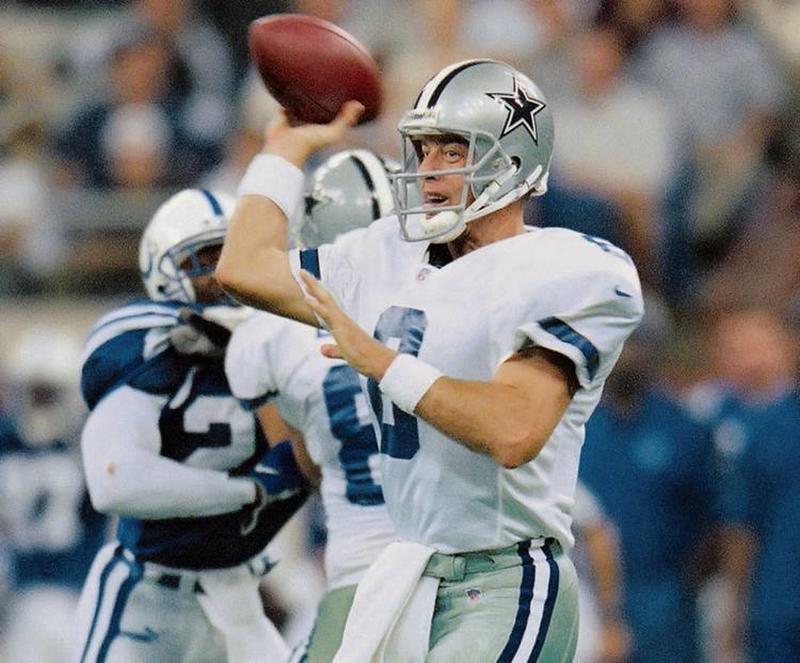
Football fans that are extra critical of the Dallas Cowboys tend to assume that the stars just so happened to align during a time the Cowboys were ascending into greatness regardless of who their quarterback was throughout the 1990s. However, despite the Cowboys having Hall of Fame talent like Michael Irvin and Emmitt Smith on their side, Troy Aikman was just as crucial to that team's success as much as any other star was on that Dallas Cowboys' offense. In 1984, Troy Aikman went to the University of Oklahoma to play football despite being contract offers from the New York Mets. Aikman became the first true freshman to start at quarterback for the Sooners since World War II. After suffering a broken ankle in his second season with the Sooners, Aikman transferred to UCLA to finish playing football. As a senior, Aikman won the Davey O'Brien Award and led the Bruins to a victory in the 1989 Cotton Bowl Classic against the Arkansas Razorbacks.
After winning with two prestigious football institutions, Troy Aikman was drafted 1st overall in 1989 NFL Draft by the Dallas Cowboys where he would play his entire twelve-season career. As a starter, Aikman finished his rookie season with a winless record of 0-11, but despite his adversities as a young quarterback, the Cowboys kept faith in Aikman which allowed him to start at the position for all twelve years of his career, the longest streak held by any Dallas Cowboys quarterback. Within those years, Aikman was able to become a 6x Pro Bowler and 3x Super Bowl Champion (XXVII, XXVIII, and XXX). Aikman was named Super Bowl MVP in Super Bowl XXVII for his four touchdown and 273 passing yard performance. Surprisingly, Aikman was never named First-Team All-Pro during his entire NFL career.
Whether celebrities are looking to be in the spotlight or escape the paparazzi, there are some popular vacation destinations that always seem to be frequented by the stars. Celeb spotting is a favorite pastime of many travelers, and you might be able to snag a photo or even an autograph when you visit these top celebrity vacation spots around the world. Although the price tags may be a bit higher in these destinations than your average budget getaway, these are some of the best celebrity vacation spots that you can start saving up to visit and enjoy the trip of a lifetime.
One of the classiest celebrity vacation spots in Europe is Mallorca, Spain. It’s known as a spot to be posh more than a spot to party. Michael Douglas and Catherine Zeta Jones have a house here, and it’s been a favorite getaway for Gwenyth Paltrow. Some of the local favorites that boast the most celebrity sightings include the Wellies Restaurant and Bar, Puerto Portals, and Es Trenc Beach.
Saint Tropez is known for its amazing beaches and blissful landscapes. Celebrity couples like Beyoncé and Jay Z and David and Victoria Beckham have been spotted vacationing along these famous beaches. The Cote d’Azur seaport is a big draw for celebs here, as well as top beach clubs like Club 55.
Perhaps the most well-known celebrity that loves Lake Como is George Clooney. He has a villa with over a dozen rooms here so he can bring all his friends along to relax, get away, and party. Villa d’Este is another popular place celebrities choose to stay because of its attention to privacy. Just ask Arnold Schwarzenegger, Bette Midler, or Sylvester Stallone!
Sure, there are plenty of celebrities that call Sydney home year-around, but there are lots of others who like to visit for a surfing and sailing getaway. Sydney’s Bondi Beach has been a top vacation pick for Leonardo DiCaprio and Hugh Jackman, and some A-list accommodations are the InterContinental Hotel and the Park Hyatt in the Rocks.