
44. There Is An Outer Space Treaty

44. There Is An Outer Space Treaty

You shouldn't assume that you're outside the law just because you're in space. There is such a thing as space law, and virtually every major country in the world has signed up to it. The original signatories were the United States, the United Kingdom and Russia, back in 1967. As of right now, there are 107 sovereign states who have agreed to be bound by its rules.
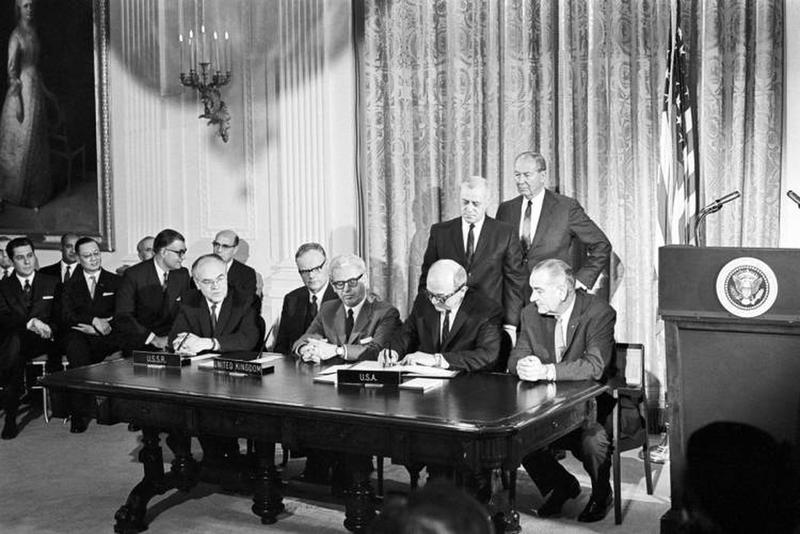
Kept deliberately basic and designed to be a foundation set of rules which can be expanded upon by our space-faring descendants, it specifically bans the placing of weapons of mass destruction either in Earth orbit, on the Moon, or otherwise stationed in outer space. It also states that the Moon and other celestial bodies should only be used for peaceful purposes, and that that the testing of weapons on them is expressly prohibited. Going further, it states the intention that the exploration of space should be pursued peacefully and for the benefit of all States and all humankind - a noble sentiment if ever we heard one.

NEXT

Did You Know...

I

When we think of inventors, the image that comes to mind is usually that of a frazzled scientist toiling away in a lab, not celebrities pulled from the pages of Us Weekly. However, a number of well-known public figures hold patents for various innovations. Some are related to the work that made them famous, while others are offshoots of hobbies or just a single great idea.

II

Part of guitar wizard Eddie Van Halen's signature sound was his two-handed tapping technique, but letting all ten fingers fly while simultaneously holding up the guitar's neck could get a bit tricky. Van Halen came up with a novel way to get around this problem, though; he invented a support (top) that could flip out of the back of his axe's body to raise and stabilize the fretboard so he could tap out searing songs like "Eruption." While Van Halen was obviously interested in improving his guitar work, the patent application he filed in 1985 notes that the device would work with any stringed instrument. Want to tap out a scorching mandolin solo? Find someone selling Eddie's device.

III

It’s probably not surprising that James Cameron—who designed a submersible to take him to the deepest known part of the ocean—will often invent technology to make his films if what he needs doesn’t exist. He holds a number of patents, including US Patent No. 4996938, “apparatus for propelling a user in an underwater environment,” that he and his brother, Michael, created to film The Abyss and patented in 1989. The device is basically an underwater dolly equipped with propellers that makes it easy for a camera operator to maneuver in the water—and allowed Cameron to capture the shots he wanted for the 1989 film, part of which was filmed in an abandoned nuclear reactor.

IV

In 1987 Jamie Lee Curtis designed and patented a disposable diaper that included a waterproof pocket that held baby wipes. She hasn't profited from her idea yet, though, since she refuses to license the patent until diaper companies make biodegradable products.

V

You know him as a rock legend, but Neil Young also loves trains—so much that he owns a stake in a model train manufacturing company and has an extensive collection. He also holds seven patents related to model trains, including Patent No. US5441223, "Model train controller using electromagnetic field between track and ground."

NEXT


Copyright © 2025 CultureHook